Why India Is Becoming a Preferred Destination for Global Aerospace Companies
 PRIYANKA
India is emerging as a key global aerospace manufacturing hub as Boeing, Airbus, Safran and other OEMs diversify supply chains. This article explores the demand-supply gap, India’s cost and engineering advantages, growing exports, domestic aviation opportunity, aerospace value chain, listed companies and key risks.
For decades, global aerospace manufacturing was concentrated around a relatively small ecosystem in North America and Europe. Boeing and Airbus assembled aircraft, while a network of specialised suppliers manufactured engines, aerostructures, landing systems, castings, forgings and thousands of precision components.
That model worked when aircraft production grew gradually.
Today, the industry is facing a different problem.
There is no shortage of aircraft demand. There is a shortage of qualified manufacturing capacity capable of meeting that demand.
Global airlines are ordering aircraft faster than the supply chain can produce them. Engine manufacturers are struggling with capacity, specialised castings and forgings remain constrained, qualification cycles are long, and decades of supplier consolidation have created dependence on a limited number of vendors.
This is where India's aerospace opportunity begins.
India is not going to replace the US or Europe as an aerospace manufacturing hub overnight. Nor is this simply another “China+1” story.
The bigger opportunity is that the global aerospace industry needs more qualified, scalable, cost-competitive and geographically diversified manufacturing capacity.
India is increasingly proving that it can provide it.
The World Does Not Have an Aircraft Demand Problem
Start with the demand side.
The global passenger aircraft fleet is expected to nearly double from around 23,000 aircraft in 2025 to approximately 46,000 aircraft by 2045.
Over this period, around 42,000 new aircraft could be required.
Some of these aircraft will cater to rising passenger traffic. Others will replace ageing fleets.
But the implication for the aerospace manufacturing ecosystem is the same: the industry has a multi-decade production requirement ahead of it.
And the existing supply chain is already struggling.
The current aircraft backlog exceeds 17,000 aircraft, equivalent to roughly 12 years of production at current capacity.
Think about what this means.
Even before accounting for the next wave of orders, Boeing, Airbus and their suppliers already have more than a decade of production visibility.
The bottleneck is therefore moving away from:
“Who will buy the aircraft?”
towards:
“Who can manufacture all the parts required to deliver them?”
The Bottleneck Is Not the Final Aircraft Assembly Line
When people think about aerospace manufacturing, they usually imagine a Boeing or Airbus factory where the aircraft finally comes together.
But most of the industrial complexity exists much deeper inside the supply chain.
A commercial aircraft contains millions of individual parts.
Before an aircraft reaches final assembly, somebody has to manufacture:
Aircraft-grade titanium and superalloys, engine casings, turbine components, airfoils, fan blades, landing-gear parts, hydraulic actuators, fuselage structures, wings, doors, nacelles, thrust reversers, electrical wiring, surface-treated components, precision tools, fixtures and thousands of smaller machined parts.
A shortage in even one safety-critical component can delay delivery of the entire aircraft.
That is why the global aerospace problem is not simply a Boeing versus Airbus production issue.
It is a supply-chain capacity issue running through engines, castings, forgings, structures and specialised components.
Why the Traditional Aerospace Supply Chain Is Under Pressure
Aerospace manufacturing remains heavily concentrated in North America and Europe.
But these mature manufacturing ecosystems are facing several structural pressures.
The first is labour.
Aerospace requires highly specialised machinists, engineers, quality personnel, inspectors, metallurgists and manufacturing technicians. Much of the workforce in established aerospace hubs is ageing, while replacement talent is expensive and limited.
The second issue is cost.
Wages and manufacturing costs in the West have risen significantly, making incremental capacity increasingly expensive.
Third is supplier consolidation.
Over several decades, aerospace OEMs streamlined their supplier networks. That improved efficiency when everything worked normally, but it also created dependence on fewer vendors for specialised products.
Then COVID exposed the weakness.
Suppliers cut capacity, skilled workers left the industry, inventories were reduced and logistics networks were disrupted.
Demand returned faster than the supply chain could rebuild.
The result today is a global industry with extremely strong order books but insufficient capacity in several critical manufacturing layers.
Why India Fits Into This Opportunity
India's biggest advantage is not simply that labour is cheaper.
That explanation is too simplistic.
Aerospace companies do not move a safety-critical engine component to another country merely to save labour cost.
The real Indian advantage comes from a combination of:
Manufacturing capability + Engineering talent + Cost competitiveness + Scalability + Domestic aviation demand
India already has a large industrial manufacturing base.
For decades, the country has manufactured automobiles, auto components, forgings, castings, machine tools, hydraulics and precision-engineered products.
Aerospace manufacturing requires significantly tighter tolerances, more documentation, higher quality standards and longer qualification cycles.
But many of the underlying manufacturing capabilities are transferable.
A company that already understands precision machining, complex forgings, surface treatment, hydraulics and large-scale quality control starts from a much stronger position than a completely new manufacturer.
That industrial foundation is one reason India is becoming increasingly relevant.
India's Automobile Ecosystem Matters More Than It Appears
One of India's hidden aerospace advantages is its massive automotive and auto-component ecosystem.
Aerospace and automobiles are obviously not the same businesses.
A car component can never be treated with the same certification process as an aircraft engine component.
But several manufacturing capabilities overlap.
India has spent decades developing competence in:
CNC machining, forgings, castings, heat treatment, sheet-metal manufacturing, hydraulics, precision assemblies, tooling and global-quality manufacturing systems.
That helps explain why companies traditionally associated with automobiles and engineering are moving into aerospace.
Bharat Forge, Sansera Engineering and Samvardhana Motherson are good examples.
They are not entering aerospace because aircraft parts are easy extensions of automotive components.
They are entering because the industrial foundation built over decades gives them the ability to climb into a much more demanding manufacturing category.
Aerospace Certification Is the Real Moat
This is one of the most important differences between aerospace and normal contract manufacturing.
A company cannot buy CNC machines today and start supplying Boeing tomorrow.
Aerospace manufacturing typically requires multiple layers of certification and qualification.
There can be globally recognised aerospace quality certifications, customer audits, special-process approvals, traceability requirements, First Article Inspection, production validation and repeated quality audits.
Special processes such as heat treatment, chemical processing, coatings and non-destructive testing may require separate approvals.
This can take years.
At first glance, that looks like a disadvantage.
For an established supplier, however, it becomes one of the industry's biggest competitive advantages.
Once an aerospace company has spent years qualifying a supplier, validating production and integrating it into an aircraft programme, changing that supplier is not easy.
Aircraft programmes themselves may remain in production for decades.
This creates an unusual business model:
Extremely difficult to enter, but potentially very sticky once entered.
That is why the more important question is not simply how much aerospace revenue an Indian company generates today.
The better question is:
Has the company already entered and qualified inside a global aerospace programme?
Because once that hurdle has been crossed, incremental work can become much easier to win.
India's Aerospace Export Numbers Are Now Becoming Meaningful
The opportunity is no longer theoretical.
India is already becoming integrated into major global aerospace programmes.
Exports classified under HS Code 88 — aircraft, spacecraft and parts thereof — increased from approximately $1.4 billion in FY20 to around $7 billion in FY25.
That is nearly a five-fold increase in five years.
More importantly, global OEM sourcing is scaling.
Boeing sources from more than 375 suppliers in India, with annual procurement exceeding approximately $1.4 billion.
Airbus sources more than $1.6 billion annually in components and services from India and plans to increase annual sourcing to around $2 billion before 2030.
Safran has also indicated plans to increase component sourcing from India to approximately $580 million by 2030.
GE Aerospace has expanded manufacturing capacity in Pune, while global companies continue to deepen their manufacturing and engineering presence in the country.
These numbers change the nature of the story.
India is no longer asking whether it can enter the global aerospace supply chain.
It already has.
The question now is how far up the value chain India can move and how much additional work it can capture.
India's Domestic Aviation Boom Makes the Manufacturing Case Stronger
India's aerospace opportunity is unusual because it combines export manufacturing with one of the world's largest emerging aviation markets.
India's civil aviation market continues to benefit from:
Rising incomes, increasing air-travel penetration, airport development, expanding airline networks and large aircraft orders.
The number of airports is expected to more than double over the next two decades.
Indian airlines have a cumulative order book of 1,700+ aircraft, led primarily by IndiGo and Air India.
The U.S. Department of Commerce has identified the potential for India to become the world's leading aviation market by 2047.
This creates an important economic incentive for aerospace OEMs.
A country that buys hundreds of aircraft can increasingly ask:
Why shouldn't more of those aircraft also contain components manufactured locally?
And from the OEM's perspective, local manufacturing also helps position capacity closer to one of its fastest-growing end markets.
India therefore has two simultaneous opportunities:
India as an aircraft customer
and
India as an aerospace manufacturing base.
That combination is far more powerful than cost advantage alone.
India Can Become a Second Source — It Does Not Need to Replace the West
The wrong way to frame India's aerospace opportunity is:
“India will replace North America or Europe.”
That is unrealistic.
The global aerospace ecosystem took decades to build. Engine technology, specialised metallurgy, avionics, certification capability and aircraft design remain concentrated among a handful of global companies and industrial clusters.
India's more realistic near-term role is different.
It can become an increasingly important second source and incremental capacity provider.
When a global OEM already depends heavily on one supplier for a critical component, qualifying another supplier reduces risk.
When existing suppliers cannot add capacity quickly enough, an Indian manufacturer can absorb incremental programmes.
And once that manufacturer executes successfully, the customer can gradually allocate more complex work.
That progression matters:
Basic Component → Precision Component → Sub-assembly → Major Assembly → System
This is how countries move up the aerospace value chain.
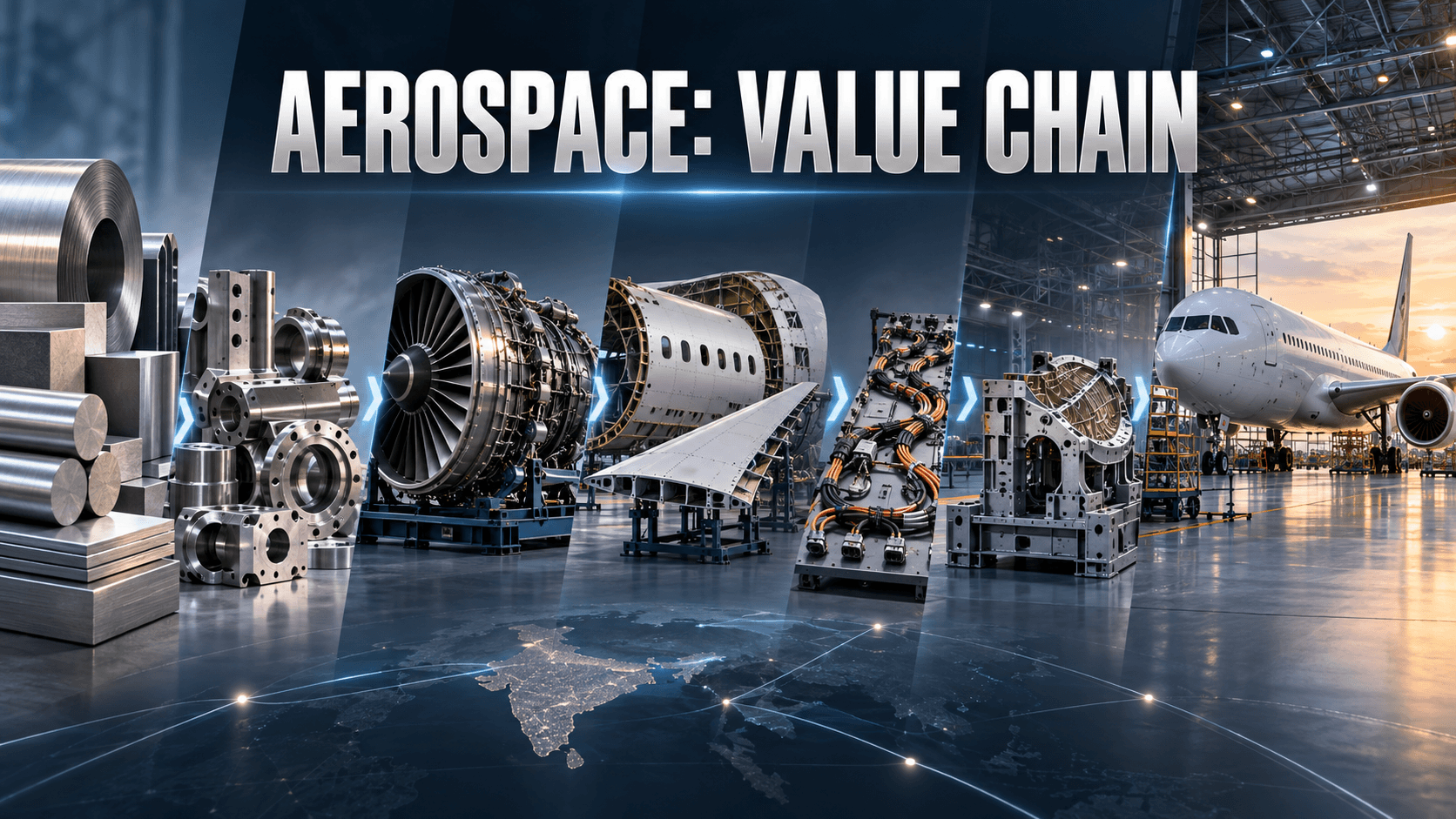
Understanding the Complete Aerospace Value Chain
The aerospace ecosystem can broadly be divided into several manufacturing layers.
| Advanced materials & metallurgy | Titanium, superalloys, specialty steels, aerospace castings | PTC Industries, MIDHANI* |
| Forgings & precision machining | Engine parts, structures, landing-gear components | Bharat Forge, Sansera, Azad, Raymond |
| Aero-engine components | Airfoils, engine casings, assemblies, hot-section components, APUs | Azad Engineering, Bharat Forge, Raymond, Sansera, Aequs, Sigma Advanced |
| Aerostructures | Wings, fuselage structures, flaps, ailerons, airframe assemblies | Dynamatic Technologies, Aequs, Samvardhana Motherson, Sigma Advanced |
| Aircraft mechanical systems | Landing systems, hydraulics, actuators, nacelles, thrust reversers | Aequs, Azad, Bharat Forge, Belrise Industries, Motherson |
| Electrical interconnects | EWIS, wiring harnesses, electronic assemblies | Rossell Techsys, Samvardhana Motherson |
| Aerospace tooling | Aero-engine tools, airframe tools, precision fixtures | Unimech Aerospace |
| Integrated aircraft/platforms | Aircraft, helicopters, engines and final platform integration | HAL* |
| Aftermarket / MRO | Aircraft maintenance, engine and component repair | HAL and expanding private/global ecosystem* |
The companies marked with an asterisk are included to complete the broader Indian aerospace value chain; the principal global-supplier table in the uploaded report focuses primarily on the private suppliers discussed below. The report's Exhibit 55 specifically maps Motherson, Bharat Forge, Sansera, Belrise, Azad, Aequs, Sigma Advanced, Dynamatic Technologies, Unimech, Raymond and Rossell Techsys to global aerospace customers.
1. Samvardhana Motherson — From Automotive Scale to Aerospace Systems
Samvardhana Motherson is a useful example of how India's existing manufacturing base can move into aerospace.
Its aerospace portfolio includes:
Metallic components, composites, electrical wiring interconnection systems or EWIS, machining, sheet metal, hydraulics, assemblies and surface treatments.
Its aerospace customers include Airbus and Boeing.
Motherson's significance lies in the breadth of manufacturing capabilities it can bring into the sector.
Rather than supplying only one isolated machined part, the company can participate across mechanical structures, composites and electrical interconnection.
That diversification is increasingly valuable as OEMs prefer suppliers capable of undertaking larger work packages.
2. Bharat Forge — Forgings Moving Into Higher Aerospace Complexity
Bharat Forge built its reputation in automotive and industrial forgings.
But aerospace takes those underlying capabilities to a much higher technical level.
The company's aerospace portfolio includes:
Machined engine components, structural components, engine fan blades and landing-gear parts.
Its global aerospace customers include Embraer, Liebherr, Rolls-Royce and Pratt & Whitney.
This is precisely the type of transition that matters for India.
The opportunity is not merely to produce more forgings.
It is to apply India's established forging expertise to much higher-value, lower-volume and technically difficult aerospace products.
3. Sansera Engineering — Precision Machining Enters Aircraft Engines
Sansera Engineering represents another transfer of Indian precision-manufacturing capability into aerospace.
Its aerospace portfolio includes machining of:
Aircraft engine casings and aircraft-door components.
Customers cited include Airbus, Boeing and Magellan Aerospace.
Engine casings are not commodity components.
They require precision machining, process control, dimensional accuracy and extensive quality documentation.
That is exactly why the segment can create higher entry barriers than ordinary engineering manufacturing.
4. Belrise Industries — Nacelles and Thrust Reversers
Belrise has entered aerospace through its Chester Hall acquisition.
Its aerospace portfolio includes:
Thrust reversers, nacelle components and structural components.
Its exposure includes customers such as Safran, Airbus and Collins Aerospace through Chester Hall.
Nacelles surround aircraft engines, while thrust reversers help redirect engine thrust during landing.
These are specialised aircraft systems rather than generic engineered products.
Belrise therefore represents another route through which Indian engineering companies can gain access to higher-complexity aerospace work packages.
5. Azad Engineering — One of the Clearest Aero-Engine Component Plays
Azad Engineering sits closer to the aero-engine and turbine component layer.
Its product portfolio includes:
Engine assemblies, Auxiliary Power Units, airfoils, actuators, hydraulic systems, airframe components and boosters.
Its aerospace customer base includes names such as:
Airbus, Boeing, Honeywell Aerospace, GE, Gulfstream, Eaton Aerospace and Rolls-Royce.
This is strategically important because aero-engine components sit among the most technologically difficult areas of aircraft manufacturing.
An aero engine experiences extreme temperature, pressure and rotational forces.
Therefore, manufacturing tolerances, metallurgy and quality requirements become substantially more demanding.
That difficulty is precisely what creates the barrier.
6. Aequs — Building an Integrated Aerospace Manufacturing Ecosystem
Aequs has built capabilities across:
Assemblies, structures, precision turnings, landing systems and engine systems.
Its customers include Airbus, Boeing, Safran, Collins, SAAB, GKN Aerospace and Honeywell.
A separate aerospace manufacturing document in the user's uploaded library highlights something strategically important about this model: aerospace OEMs increasingly prefer suppliers with integrated capabilities rather than parts constantly travelling between independent machining, forging, surface-treatment and assembly locations. That reduces logistics, improves process control and can help OEMs lower the carbon footprint of their supply chains.
That suggests the next stage of Indian aerospace manufacturing may be less about standalone
machining and more about building integrated manufacturing ecosystems.
7. Sigma Advanced Systems — Engine Components + Aerostructures
Sigma Advanced participates across two difficult layers.
Its engine capabilities include:
Class-1 fabrications, sub-assemblies and hot-section components.
Its aerostructure exposure includes:
Critical airframe structures.
The customer list cited in the report includes global aerospace companies such as Rolls-Royce, Airbus, Safran, Boeing and GE, among others.
The significance is the combination of engine and airframe capability.
Indian suppliers that can successfully manufacture across multiple complex aerospace categories can potentially increase wallet share with existing OEM customers over time.
8. Dynamatic Technologies — India Moving Into Larger Aerostructures
Dynamatic Technologies provides one of the clearest examples of India moving beyond small precision components.
Its aerospace portfolio includes:
Wings, rear fuselages, ailerons, wing flaps and major airframe structures.
Customers include:
Airbus, Boeing, Bell Helicopters, Dassault Aviation, Deutsche Aircraft and Spirit AeroSystems.
This is a meaningful step up the value chain.
Machining an individual component is one level of manufacturing.
Producing complete wings, fuselage structures and major aerostructure assemblies requires a much deeper combination of tooling, process control, supply-chain management and assembly capability.
9. Unimech Aerospace — The Tools Behind the Aircraft
Aerospace tooling is an easy layer to overlook.
Before an aircraft engine or airframe can be manufactured repeatedly, factories require highly specialised tools, fixtures and precision manufacturing equipment.
Unimech Aerospace operates in this niche.
Its exposure includes manufacturing of aero-engine and airframe tools, with programmes linked to names such as:
LEAP, Pratt & Whitney, Rolls-Royce, Airbus and Boeing.
This illustrates an important point.
The aerospace opportunity is not confined to companies producing parts that physically fly on aircraft.
There is also an entire ecosystem supplying the equipment required to manufacture those parts.
10. Raymond — Precision Engineering Becomes the Core Story
Raymond's aerospace exposure comes through its engineering businesses.
Its portfolio includes:
High-precision engine components and assemblies.
Its aerospace customers include Safran, Eaton Aerospace, GE Aerospace and Honeywell Aerospace, among others.
The larger strategic point is similar to the rest of the Indian aerospace story.
A company that already possesses precision-engineering capability can gradually move towards harder products with longer qualification cycles and potentially stronger customer stickiness.
This transition from general engineering towards high-value aerospace work is where the business model becomes more interesting.
11. Rossell Techsys — The Electrical Nervous System of an Aircraft
Aircraft are becoming increasingly electrical.
Rossell Techsys operates in the electrical interconnection layer through:
Wire harnesses, electrical interconnects, electronic assemblies and specialised test equipment.
Its customer base includes major global aerospace companies.
An aircraft can contain kilometres of wiring connecting engines, sensors, flight controls, cockpit systems and other equipment.
This makes EWIS and electrical interconnects a critical manufacturing category rather than a peripheral one.
Rossell gives listed investors exposure to a very different part of the aerospace value chain compared with engine or aerostructure companies.
MRO Could Become the Next Major Aerospace Opportunity
Manufacturing the aircraft is only the beginning of the economics.
Commercial aircraft can remain in service for decades.
Throughout their life they require:
Scheduled maintenance, component replacement, engine servicing, airframe checks, repair and overhaul.
India historically lost a significant portion of this spending to overseas MRO facilities.
That is now beginning to change.
Government measures highlighted in the report include:
100% FDI permission, rationalisation of GST on aircraft and engine parts to 5%, and longer export/re-import timelines for repair work.
Industry investment is following.
Air India and Singapore Airlines Engineering are developing maintenance capability in Bengaluru.
GMR Aero Technic has entered specialised MRO arrangements.
Airbus and HAL plan to establish A320-family maintenance capability.
Safran has established a large LEAP engine MRO facility in Hyderabad.
IndiGo is also building additional MRO capability in Bengaluru.
As India's installed aircraft fleet expands, aftermarket demand becomes increasingly difficult to ignore.
The same domestic order book that supports aircraft sales today can create an MRO, spares and lifecycle-services opportunity for decades.
Why Aerospace Can Be an Attractive Business Once Qualification Is Complete
Aerospace differs from many conventional manufacturing sectors.
Volumes are lower.
Development cycles are longer.
Customer qualification is difficult.
Capex can be significant.
But successful suppliers can benefit from several attractive economic characteristics.
Aircraft programmes can run for decades.
OEMs are reluctant to change a proven supplier without reason.
Qualified suppliers can gradually receive additional work packages.
A company may initially manufacture a relatively simple component and later move into assemblies, structures or more complicated engine parts.
This means the industry often follows a staircase:
Qualification → Small Revenue → Execution Track Record → Larger Work Package → Higher Complexity → Greater Wallet Share
The important thing for investors is that the first step can take years.
Aerospace is therefore rarely a “next quarter” story.
Conclusion
India is not becoming important to global aerospace simply because it offers cheaper manufacturing.
That would understate what is happening.
The world needs thousands of new aircraft.
Existing aerospace hubs are capacity constrained.
Engine, casting, forging and specialised-component supply chains remain tight.
OEMs want additional qualified suppliers and greater geographical diversification.
At the same time, India offers a large engineering talent pool, decades of precision-manufacturing capability and one of the world's fastest-growing aviation markets.
And most importantly, Indian companies have begun crossing aerospace's hardest barrier:
global qualification.
Samvardhana Motherson, Bharat Forge, Sansera Engineering, Belrise Industries, Azad Engineering, Aequs, Sigma Advanced, Dynamatic Technologies, Unimech Aerospace, Raymond and Rossell Techsys are already participating across different parts of the global aerospace supply chain.
HAL provides deeper integrated aerospace manufacturing capability on the domestic platform side, while India's expanding aircraft fleet is creating a parallel MRO opportunity.
India will not become the next Boeing or Airbus tomorrow.
It does not need to.
The bigger opportunity is for India to become one of the world's most important qualified manufacturing partners to Boeing, Airbus, Safran, Rolls-Royce, GE Aerospace, Pratt & Whitney and their global Tier-1 suppliers.
That transition has already started.
And as India moves from:
Components → Assemblies → Systems → Aircraft → MRO
the amount of aerospace value captured inside India can keep rising for years.
_1783769780040.png&w=3840&q=75)
_1783766890311.png&w=3840&q=75)
_1782728608439.png&w=3840&q=75)







_1768996873080.png&w=3840&q=75)



_1755606872650.png&w=3840&q=75)